Friday, May 31, 2013

Frugal Friday: Kitchen Tip/Tutorial: How to Culture Buttermilk

I have another kitchen tip/tutorial to share with you today for Frugal Friday that can save you money. I'm going to show you how you can culture your own buttermilk. It is so easy to do and literally takes only a few minutes of your time. Before I learned this trick I was too cheap to buy buttermilk and would always just use the kitchen substitute of milk and a little vinegar. Well, that works, but oh my goodness, this is so much better. Have you tasted buttermilk pancakes with real buttermilk? Or buttermilk syrup? Heavenly. (...and yes and I can make that syrup sugar free believe it or not...) So...before I share with you any of those wonderful recipes, I have to show you my slick way to culture buttermilk. Because it's cheap. And cheap is good. And it's Frugal Friday so cheap is what we do.


How to Culture Buttermilk:
Printable Recipe

INGREDIENTS:
1/2 Pint Buttermilk (from the store - make sure it has active cultures) or 1 cup buttermilk from a previous batch
3 Cups milk (any % is fine)
Clean glass jar

No you don't need a Bosch mixer to do this...oops...

DIRECTIONS:
Step 1: Pour buttermilk with active cultures in clean canning jar. Make sure the buttermilk either has active cultures (it should say on the carton), is fresh, or from a batch that you've cultured from within the last week.

Step 2: Fill up the rest of the glass container with milk.


Step 3: Put the lid on the jar and shake well.
Yes, I usually shake mine over the sink...just in case...
Step 4: Cover the jar or keep it out of direct sunlight. Let the jar sit to culture on the counter for 12-24 hours. The time will depend on the temperature, how active your cultures were, etc.

Step 5: Test buttermilk to see if it's ready by pouring into a glass. When ready, buttermilk will have thickened some and will coat the sides of the glass. Smell it. It should smell heavenly, not sour. If it smells sour, chances are you've forgotten it on the counter and it got a little too "ripe". It will still be good, but chances are you won't be able to use it to culture your next batch. When you get the time ratio just right you should be able to propagate the stuff for quite a while. If it starts going a little too sour, just buy another 1/2 pint and start over. Easy and frugal.

The cost savings? Well as a rule, milk is cheaper than buttermilk. It should make sense then that if you use only 1/4 buttermilk and 3/4 milk and come out with a quart of buttermilk, that would be cheaper than buying a quart of buttermilk outright. Especially when you consider that you can then use that buttermilk to make more buttermilk and...the cycle can continue indefinitely. It's a wonderful thing and a frugal thing.

Have you ever tried culturing your own buttermilk? What's worked for you? Happy Frugal Friday. Have a great weekend.

This week I'll be linking to some of these link parties.

Tuesday, May 28, 2013

Peanut Butter Oatmeal Cookies (Sugar Free)

I'm happy to say that I've completed almost five months of sugar-free six days a week. It's going great. I love finding more recipes to add to my sugar-free repertoire. These sugar free peanut butter oatmeal cookies use honey or xagave as the sweetener and are tasty as can be. I've adapted the recipe from one by Weelicious to make them not only sugar free but also to use 100% whole grain flour. Enjoy.


Peanut Butter Oatmeal Cookies
Printable Recipe

*Makes 30 cookies

INGREDIENTS:
1/2 Cup butter, softened
1/2 Cup honey or xagave
1 egg
1 tsp. vanilla
1 Cup peanut butter
1-1/2 Cup whole grain flour (my choice would be oat flour or wonder flour)
1 Cup rolled or quick oats
1 tsp. baking soda
1/2 tsp. salt

DIRECTIONS:
Preheat oven to 350. In a stand mixer, combine the butter and honey (or xagave) and mix for about one minute. Add the egg, vanilla and peanut butter and beat for another minute or until smooth. In a separate bowl combine together the dry ingredients and mix. Slowly add the dry ingredients to wet and mix to incorporate. Scoop dough into two tablespoon amounts and drop onto ungreased cookie sheet. Using a fork, press gently down on each ball of dough to make a checkerboard pattern. Bake at 350 for 10-12 minutes or until slightly brown.

*Recipe Source: Adapted from Weelicious

Friday, May 24, 2013

Frugal Friday: Keeping Summer on a Budget

Summer's here and I can't believe it. Today is my oldest son's last day of school. Last year at this time I was kind of freaking out. I needed an idea for summer so that I didn't go crazy. I came up with this printable summer plan that we used all summer long and I'm happy to report that it worked so well that I am using it again.

One of our favorite things about the summer plan is that there is something to look forward to each day of the week. Those incentives help our kids want to do their chores and assignments early in the day (ideally without complaining...but realistically of course that doesn't always happen) so that they can participate in the activities.

Another thing I love about the plan is that it provides just enough structure for our kids to feel like they are on a schedule, along with just enough "non-structure" to allow them lots of free time to just be kids. I believe in slowing down during the summer, but I don't believe in complete laziness. Kid's want to accomplish and succeed and we can allow them that by giving them responsibilities and expectations (as well as rewards and incentives) each day.

The plan also helps us to stay on budget because everyone knew what to expect about which activities will cost money and which will be free. This is important during the summer because it's so easy to blow the budget when there is no plan.

As I mentioned, in this plan there are themed activities for each of the days of the week. Here's how the activities break up for each day of the week:

  • Make Something Monday - We make a craft, project, snack or treat.
  • Library Trip Tuesday  - We go to the library, check out books and sometimes go to story time.
  • Wet, Wet, Wednesday - We run through the sprinklers, wash the cars or bikes, make bubbles or do another wet activity.
  • Thinking Thursday - We do an activity that helps us learn - a science project, learn some words from another language, have a read-a-thon or another learning activity.
  • Field Trip Friday - We go on a field trip somewhere - to the park, to the zoo, to the swimming pool or splash pad. Some cost money, some are free. We plan them ahead of time so everyone knows what to expect.

During the summer I like to encourage the kids to do extra chores for money. We list those on the upper left corner of the plan along with how much they can earn. Summer is a great time to help your kids learn to work and enjoy working by providing them with chores where they can earn money. What works best for us is to make these chores optional, but expect the kids to fund the cost of some of the activities themselves. For example, last year we went to our city carnival with the kids on a day when all the rides were cheaper. During the week I gave the kids lots of chores where they could earn money and told them that the money that they earned that week could be spent at the carnival. They paid for all the rides and snacks that they wanted and there was no complaining because when their money ran out, we went home. It was a great way to teach responsibility as well as help them to discover the rewards that hard work brings.

Throughout the summer I'll be sharing examples of activities that we do as part of this plan in case you need ideas. Make sure you follow my facebook page because that's where I'll post most of these.

Happy Summer! Ready or not, here it comes. :)

Tuesday, May 21, 2013

Cilantro Lime Brown Rice {Electric Pressure Cooker Recipe}

We love Mexican food. And I'm always on the lookout for a good Mexican dish that is healthy. So many Mexican recipes use white rice or a lot of meat, both of which we try to use in moderation. Here's a delicious side-dish recipe that we love that uses brown rice. Brown rice is better for you than white rice because it contains the outer hull, making it a whole grain with lots of fiber and nutrition. Cooking brown rice in the pressure cooker is so amazing - it comes out light and fluffy and soft in about half the time it takes to cook on the stove. It really is the best way to do it. We love to serve this as a topping on this yummy Mexican black bean salad


Cilantro Lime Brown Rice {Electric Pressure Cooker Recipe}
Printable Recipe

*Serves 3-4

INGREDIENTS:
1 Cup Long Grain Brown Rice
1-2/3 Cups Chicken Broth
1 tsp. butter
1/2 tsp. garlic, minced
1 Tbsp + 1 tsp. fresh lime juice, divided
1-1/2 tsp. white sugar
3 Tbsp. fresh cilantro, chopped finely

DIRECTIONS:
In an electric pressure cooker combine the long grain brown rice, chicken broth, butter, garlic and 1 tsp. fresh lime juice and mix until combined. Bring to high pressure and cook for 21 minutes. Naturally release the pressure. While rice is cooking, mix in a small bowl 1 Tbsp. fresh lime juice, white sugar and finely chopped cilantro. When rice is done cooking, fluff with a fork and mix in the lime/sugar/cilantro mixture. Serve immediately or keep on warm setting until ready to serve.

Recipe Source: healthyfamilycookin.blogspot.com

Friday, May 17, 2013

Frugal Friday: Kitchen Tip/Tutorial on Bread Dough

This week I shared with you another great bread recipe that I love for whole grain spelt bread. While I'm certainly no expert, I've been told that I have a talent for making good bread, and making whole grain bread that is healthy as well as delicious has become quite a passion of mine. I've had a lot of bread success, but with that comes some failed attempts as well. Those attempts are discouraging I know. It's especially hard when you try to follow a recipe, but it still just doesn't turn out the way the recipe suggests it should. I've decided in the next few months that I want to share with you information that can help you to become a successful bread maker. There are some secrets that you just can't detail enough in a recipe. And I'd like to share those with you. A few months ago I shared with you a kitchen tip/tutorial all about yeast. If you haven't read it yet, go read it. It's kind of Bread Tutorial 101, and a precurser to what we'll talk about today. Today we're going to talk about adding the correct amount of flour to get the right bread dough consistency.


Bread is a tricky thing because in recipes you can't list the exact amount of flour that you'll need in a recipe. It depends on so many things: humidity, temperature, the type of flour you use, how you measure the flour, etc. So unless you've seen it before, how do you know exactly how much flour that you need? Well today I'm going to eliminate the "guesswork" and show you in a video that I created exactly how much flour you need to make perfect bread.

I created this video this week and I am so excited to share it because this happened to be one of the best batches of bread that I've ever made. It had the perfect amount of flour (and even as much as I make bread that's hard to do every single time). Please excuse the informal quality of the video. I was literally videotaping with one hand while I demonstrated with the other. During parts you can even see the lense cap bobbing back and forth - hee hee. It was the best I had available to me and you can still get the idea even in spite of it's unprofessional quality.

Why am I sharing this for Frugal Friday? I posted about how much money you can save by making your own homemade bread, but that will only work if you actually know how to make it. I hope by sharing this video that it will give you what you need to get started baking your own bread. You can start saving your family money as well as help them eat healthier.


Here's the recipe that I used in the video, but you can use any of the yeast loaf bread recipes on my bread recipe page. They're all great and I love them. There is a little difference for freestanding loaves (like French Bread) and rolls, so look for the tutorial on those to come soon.

Don't have a mixer? Don't worry. You can still make this bread by hand. A friend of mine uses my recipe and makes it by hand and loves the result. You do have to make a few adjustments though. My plan is to demonstrate that in a future kitchen tutorial so stay tuned.

One of my readers shared a comment that I want to share that might help you. She said that she started making their own homemade bread (yes, by hand) and then put the amount that they were saving from buying bread at the store each week into an account. She said that it only took about a year until she had enough saved to buy a Bosch Mixer. What a great idea!

And now I'd love to hear from you. Do you make your own bread? Got any tricks to share?

Happy baking! Have a great weekend.

Tuesday, May 14, 2013

Whole Grain Spelt Bread

I've used this basic whole-wheat bread recipe for several years now. I love it. It's reliable, quick, and simple, with fabulous results. A few months ago I taught a bread class to some wonderful women. It was a lot of fun. I taught them to make my whole-wheat bread as well as these cornmeal crescent rolls. One of the ladies mentioned that she has a hard time digesting whole-wheat bread, which is one of the reasons she doesn't make much homemade bread. I asked her if she had heard of spelt, which is a grain that is actually a species of wheat, that some people with wheat allergies can handle. Now I am not talking about the Celiac disease, that's a completely different deal. My dad has Celiac and can't eat any type of gluten at all. Other people have just a wheat allergy, and can still handle grains that contain gluten like Spelt. That discussion led me to experiment a little with spelt and I created this wonderful whole grain spelt bread. If it looks a little similar to my whole-wheat bread, that's probably because it is. :) It's the same recipe using whole grain spelt flour instead of whole wheat flour. The result? Amazing. I loved it. It was lighter tasting that whole wheat bread and absolutely delicious. Enjoy!


Whole Grain Spelt Bread
Printable Recipe

*Makes 3 loaves

INGREDIENTS:
3 Cups hot water, heated until quite warm ( >110° F) *I put mine in the microwave for 2-3 minutes to heat it
1/3 Cup canola oil
1/3 Cup sugar
1 Tbsp. salt (put in first before adding yeast)
½ Cup gluten flour*
½ Cup ground flax seed, optional (adds a great texture)
½ Cup rolled or quick oats, optional
3 Cups + more freshly ground whole grain spelt flour *the amount is not exact because it depends on various factors
2 Tbsp. instant yeast on top of flour *be sure to check out my kitchen tip/tutorial on yeast

DIRECTIONS:
Combine above ingredients in heavy duty stand mixer (like a Bosch) with dough hook and mix. Add more whole wheat flour until the dough pulls away from the sides of the bowl. Then mix for an additional six minutes. Divide dough into 3 loaves (the dough will still be VERY sticky - so sticky that you won't be able to form your loaves without putting oil on your hands, but make sure that there is enough flour that it still pulls away from the sides of the bowl when you’re mixing it). Put dough in oiled pans. Let rise until double or until the bread fills the pans. While bread is rising, preheat the oven to 400 degrees. When the bread has risen, bake it at 400 deg. for 5 minutes. Then turn down the heat to 350 degrees and continue baking for 25 min or until done.

*NOTE on the Gluten flour: I use Bob's Red Mill Vital Wheat Gluten Flour that I buy at WinCo foods in their bulk bins - or you can get a 25 lb. bag of it there if you order it. I think you can also get it at Walmart in smaller quantities - like 22 oz. pkgs. You only use 1/2 cup for 3 loaves so it lasts a long time. It allows you to make the bread with whole-grain flour and still have it light and fluffy and stick together. This really is not an optional ingredient - you can try to leave it out, but you will end up with denser bread that is crumbly, doesn't have as long of a shelf life, and really is not as enjoyable to eat. Another option (if you're looking for one) is to use a good quality, high gluten white flour instead of some of the whole-wheat flour (experiment with how much - maybe 2 cups or more to get it to a good stick-together consistency). I'd rather spend a little more for the gluten flour because you can use less of it (which means more whole-grain flour which is better for you) and still have a great textured, tasty bread.

Recipe Source: healthyfamilycookin.blogspot.com

What could taste better than hot, fresh bread and butter for a healthy afternoon snack?

Do you or anyone you know have wheat allergies? Have you tried using other grains in your baking? I'd love to hear about it. Thanks for sharing and have a great day!

Friday, May 10, 2013

Frugal Friday: Cost Analysis of Dried beans versus Canned

For today's Frugal Friday post I'd like to explore the cost savings of buying dried beans versus canned. Early this week I posted a recipe about how to make refried beans in the pressure cooker. I alluded to the fact that it's a lot cheaper to cook dry beans from scratch than to buy canned beans. But today I'd like to do the math so that you can see for yourself really how much money you can save by cooking dry beans instead of buying canned beans.

I'm going to specifically compare the price of buying and cooking dry black beans with the price of buying cans of black beans. Because all beans are slightly different in size, cooking time and cost, this analysis will vary slightly if you want to compare a different kind of bean. But I think the conclusions that I present will represent a general rule for all dry beans.

Two important facts about black beans:
  1. 1 cup of dried black beans yields about 3 cups of cooked beans.
  2. Each 13.5 oz. can of black beans contains about 1-3/4 Cups of cooked beans.
DRY BEANS:
At WinCo right now, the bulk bin price for most kinds of beans (including black beans) is about $1/lb. give or take a few cents. I've found that 1 lb. of black beans is almost exactly 2 Cups dried beans. As per fact #1 above, 2 Cups dried beans will yield about 6 cups of cooked beans.  So 6 cups of cooked black beans will cost roughly $1. If you divide $1 by 6 cups you will find that cooked black beans (from dry beans) will cost about $0.17 per cup.

I can find dry beans a lot cheaper if I buy them in large quantities. I can buy 25 lbs of black beans for $16 (or less). That's $0.64 per pound or $0.11 per cup of cooked dry beans (bought in large quantities).

CANNED BEANS:
Lets compare these prices with the prices for canned black beans. At the grocery store, I can sometimes find canned beans for $0.59 a can on sale. That's a good price, the non-sale price will be closer to $0.75. As per face #2 above, each can will yield 1-3/4 cups of cooked black beans. If I divide the price ($0.59) by 1.75 (for 1-3/4 Cups), I find that buying canned beans at the store (on a really good deal) costs $0.34 per cup of cooked beans. 

ELECTRICITY:
I cook my beans in an electric pressure cooker, but you can also cook them on the stove or even in a crock pot. I'm going to use the pressure cooker to calculate electricity because that's what I use. My electric pressure cooker runs on 1000-Watts or 1KW. As I mentioned in my cost analysis of homemade bread, our electricity costs about $0.10 per kWh (kilowatt hour). Black beans take about 20 to 50 minutes to cook (depending on the recipe and whether you soak them or not). So at the most, the electricity will cost about $.08 to cook a big batch of beans. When that's divided over 6 Cups of cooked beans, that's a little more than $0.01.

CONCLUSION:
Buying canned beans from the store will cost at least twice as much as it costs to buy dry beans and cook them at home. With pressure cookers now to make it easy, there really is no excuse to make your beans from scratch. Not only do you save money, but you can also completely control what goes into the beans by cooking them yourself.

Happy Frugal Friday! I'd love to hear your thoughts or ideas on how to save money. Have a great weekend.

This week I'll be linking to some of these link parties.

Tuesday, May 7, 2013

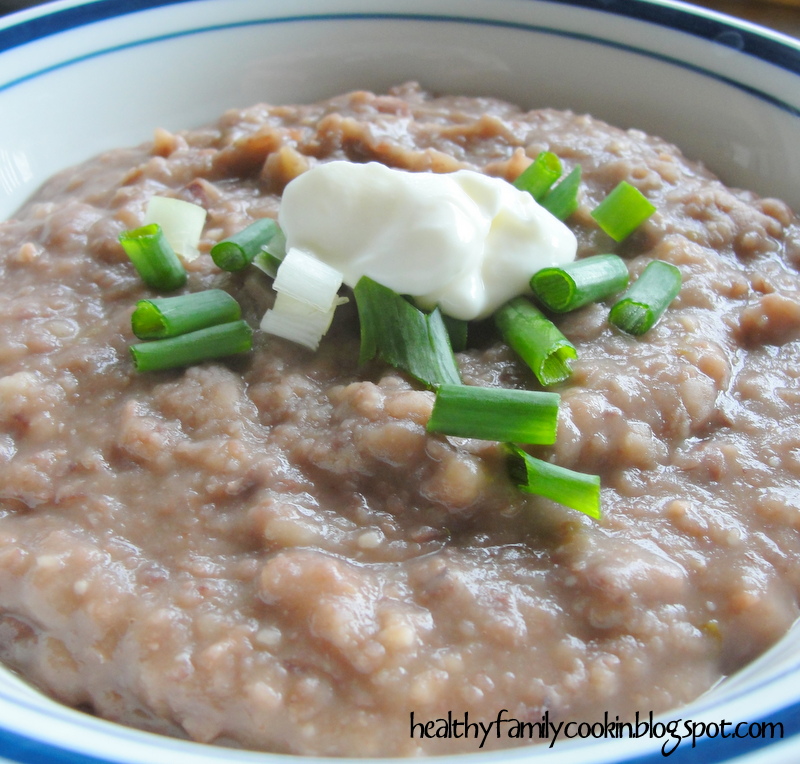
Pressure Cooker Refried Beans

One of my favorite uses for the pressure cooker is making beans from scratch. I hardly even look at recipes that use canned beans anymore because dry beans are such a cinch in the pressure cooker. Dry beans are so amazing because of their storage properties - they can store forever! Well not forever, but for a long time (10 years or more if you store them right). I love to buy them in bulk and keep them in my pantry so that I always have them when I want to cook with them. Beans have a lot of protein and are very good for you. Plus they are a lot cheaper than meat. Our family loves black beans and we make this recipe for Mexican black beans a lot.

Today I want to share another amazing recipe that you can make with dry pinto beans from your storage. These are so yummy and you will never want to go back to canned refried beans again. I found the original recipe on Kalyn's Kitchen and adapted it slightly when I made itI love this recipe because it uses simple ingredients that you can keep on hand and turns out totally, amazingly delicious.

These green onions are from my garden :)


Pressure Cooker Refried Beans

*6-8 Servings

2 Cups dried pinto beans
3 Tbsp. olive oil, divided
1 Cup chopped onion
2 Tbsp. minced garlic (no, this is not a typo...)
1 4-oz. can diced green chiles
1 tsp. salt
sour cream, for serving
sliced green onions, for serving

Sort dry beans by removing rocks and impurities. Then put them in a colander and rinse well to remove all the dirt.  Put beans in pressure cooker with enough water to cover by 1 to 1-1/2 inches. The exact amount of water is not important but too much is better than too little. Add 1 T olive oil to cooker, then lock lid, bring to high pressure, and cook 30 minutes. After 30 minutes, turn off heat and use a quick pressure release.

When pressure has released, add chopped onion, minced garlic, canned green chiles, and salt to pressure cooker. Lock lid again and pressure cook 10 to 20 minutes, depending on how old the beans are. For newly purchased beans start with 10 minutes. Older beans will take longer to cook, so start with 15 minutes. You want the beans to be fairly soft and starting to crack open. If you get open the pressure cooker and the beans are not quite soft, just re-lock the lid, bring up to pressure and cook another 5 to 10 minutes.

When pressure has released the second time, remove lid and without draining, mash or puree beans to desired consistency. You can use an immersion blender, a potato masher or a regular blender. The trick is to get the consistency right and it kind of depends on how your tastes. If you like whole beans in your refried beans, make sure you don't blend or mash all the beans. If you like them really smooth, blend more. Personally, I like my refried beans somewhere in the middle, some parts chunky, some parts smooth. I put about half of the bean mixture in the blender and pulse a couple of times - so it's still chunky. Then I put the other half in a pulse it until it's a little smoother. Then I combine the two parts and that's how I like it. The mixture may still be runnier than you like. That's fine. Don't worry about draining any liquid off, it will thicken up in the next step.

When beans are as smooth or chunky as you prefer, heat 2 Tablespoons of olive oil in a heavy, nonstick pan. Add beans and simmer over medium-low heat, stirring often, until beans have thickened to desired consistency. It should take only about 10-15 minutes. Serve hot, topped with sour cream and thinly sliced green onions, if desired. Other serving ideas include: over Navajo tacos, with chips, in a bean burrito, in taco salad, in tacos, or in tostadas; the possibilities are endless.

Recipe Source: Recipe slightly adapted from Kalyn's Kitchen

Friday, May 3, 2013

Frugal Friday: Kitchen Tip/Tutorial: How to Dehydrate Bananas

If you've ever tried making banana chips at home in your dehydrator, you know that it's not as easy as it sounds. Did you know that most banana chips you buy from the store are actually fried in oil? They contain lots of saturated fat and sugar and really aren't all that healthy for you. When you try to make them at home, they turn out like shriveled up little ugly brown things and while they taste okay, they are an absolute pain to make. Cutting all of those little slices and arranging them on the dehydrator trays. They are sticky so they stick to the sheets and wow, what a pain. And they don't even come out crunchy. Just kind of leathery, not matter how long you dehydrate them. I decided after making them the first time that they were not worth it. And after that experience I kind of gave up on dehydrating bananas until...

One day I was visiting my aunt and she had just found a really good deal on bananas and had bought a whole bunch. She taught me this method for drying them and I love it. It works and it's fast and easy and you can dehydrate a whole bunch of bananas at time. They don't come out crunchy like banana chips, but I actually like them better. They are chewy and delicious. They are much healthier because they are just bananas and aren't fried in fat. And you can easily re-hydrate them to use in a lot of yummy recipes. 


Since this is Frugal Friday I'm going to take a slight detour and tell you a story about buying bananas. We have a grocery store about 2 minutes away from our house and I love it. One thing that I love about it is their produce because they often have good sales. I went there not too long ago and found that bananas were on sale for 26 cents a pound. Anyone who buys produce must know that that's a really great price for bananas. These weren't the mushy overripe ones either. These were the good bananas. So I decided that I would buy some to dehydrate. Well I had three bunches in my cart and then I saw that they had 40 lb. boxes of bananas for sale as well. And I thought, Oh cool, maybe I could get a case for even cheaper. The price on the case said $19.99. Doing the math surprised me because the cases of bananas were about 50 cent a pound instead of the 26 cents a pound that they were charging for the other bananas. Almost twice as much! Needless to say I didn't buy the case and stuck with the 3 bunches that I had in my cart. Lesson learned: always do the math!


How to Dehydrate Bananas
Printable Tutorial

Now back to the tutorial. For best results start with bananas that are ripe, but not too ripe. I don't think a few spots will hurt, but if they've gone mushy, better use them for a smoothie or something.


The first step in dehydrating bananas is pretty obvious: peel them.


I love this next step because it is just so awesome. Did you know that a banana is naturally segmented just like an orange or lemon or those other kinds of segmented fruits? It's naturally segmented into three equal parts. Isn't that cool? To segment the banana, gently slide your thumb into the end of the peeled banana that has a slight opening (the non-stem side).


Continue sliding down your fingers through and you will be left with three equal banana segments. If it breaks part way down, don't worry. You can still use it. Just put your thumb where you left off and keep sliding.


Lay your banana segments on the food dehydrator sticky side up. That's right! No stickiness to worry about with this method. Yay!


Repeat these steps until the dehydrator is full. I fit about 3 bunches full of bananas on my 5 trays. That's another thing I love about this method, you can fit a lot of bananas at a time. Then dehydrate for about 12-24 hours depending on your dehydrator and how thick your bananas are. Mine took about 15 hours or so. Bananas are done when they are still bendable, but not sticky. Store in an airtight container (out of direct sunlight) until ready to use.

Source: healthyfamilycookin.blogspot.com, idea shared by my Aunt Sharilyn


Dehydrating your own bananas can be a great way to save money. You can buy bananas when you find them on sale and dehydrate them as a yummy snack or for use in many recipes. 

And now I'd love to hear from you. What did you do to save money this week? Happy Frugal Friday and have a great weekend.

This week I'll be linking to some of these link parties.

Popular Posts

LinkWithin

Related Posts with Thumbnails